SCIENTIFIC RESEARCHES IN SAHAJAYOGA
MEDITATION RESEARCH
INTRODUCTION
Meditation is the practice of entering a higher state of consciousness that transcends the thinking mind and elicits the state of thoughtless awareness or mental silence.
Sahaja Yoga Meditation is a traditional Meditation technique that trains the practitioner in achieving this state of mental silence on a regular basis.
Although the original goal of Meditation is spiritual growth, important therapeutic side effects on physical and mental health have attracted medical research.
The state of thoughtless awareness has thus been shown to elicit important beneficial changes in the body and the brain and has therapeutic effects on a wide range of disease processes.
This webpage is informing about international research on the physiology and neurophysiology of this state of thoughtless awareness and on the beneficial therapeutic effects on various diseases and disorders.
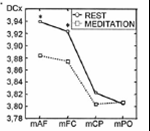
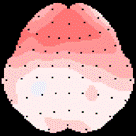
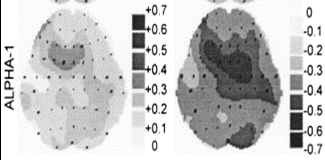
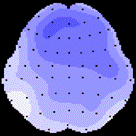
In their EEG measures, the long-term meditators showed increased power in low band frequency EEG activity of theta, which was particularly pronounced over the left frontal regions. The intensity of mental activity correlated negatively with theta activity over frontal and central brain regions, suggesting that less internal dialogue is related to more activation. Frontal theta activity is thought to originate from limbic and frontal regions regions such as the anterior cingulate and prefrontal cortex and has shown to be increased during both affective and attentional states such as emotion processing and sustained attention.The intensity of the feelings of happiness was positively correlated with the theta activity over left frontal regions. This is in line with the evidence for a role of the left frontal lobe in positive emotions whereas the right prefrontal lobe plays a greater role in negative ones.There was also increased activation in the alpha power range over the same regions, which is thought to reflect a reduction in brain regions that mediate mental effort and external attention. Increased activation in alpha activity has commonly been observed in Meditators of different traditions and been found to correlate with reduced levels of anxiety.In addition to enhanced fronto-parietal theta activation, the authors also found enhanced connectivity of fronto-parietal theta bands - suggesting the enforcement of attentional networks.A reduction in the chaotic dimensional complexity was also observed suggestive of the inhibition of task-irrelevant processes.
Taken together, the findings suggest that during Meditation, the reduced mental activity is mediated by increased activation of networks of internalised attention which seem to trigger the activity in regions that mediate positive emotions (left frontal cortex) while decreasing networks related to external attention and irrelevant processes.
The enhanced connection between frontal and parietal regions is probably the prerequisite for the general intensification of internalised attention necessary for the induction of the altered state of mental silence.
In conclusion, this ground-breaking study shows that the subjective experiences of mental silence and positive emotions during Meditation have very specific neurophysiological correlates in the activation and connectivity of regions that mediate internalised attention and positive affect.
BRAIN EFFECTS
Effects of Sahaja Yoga on brain activation:
Electrophysiological studies (EEG) measure the electrical activity from groups of neurons on the surface of the scalp. EEG studies comparing the brain activation of long-term Sahaja Yoga practitioners (11) to short-term Sahaja Yoga meditators (16) found specific brain activation patterns corresponding to the subjective feelings of thoughtless awareness and happiness experienced by the Meditators (Aftanas and Golocheikine, 2001, 2002, 2000). In their EEG measures, the long-term meditators showed increased power in low band frequency EEG activity of theta and alpha, which was particularly pronounced over the left frontal regions.
Brain activation correlating with thoughtless awareness and happynesss:
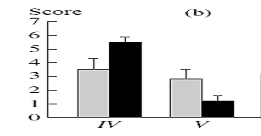
During the Meditation, the long-term meditators showed less mental activity, i.e. less thoughts (IV) and more feelings of happiness (VI) according to their subjective ratings.

With the spreading of Sahaja Yoga, it became well known that water can be vibrated by Shri Mataji, directly by her personal impact or in the presence of her photograph. Many people experienced medicinal properties of such water.
Vibrated water doesn't get spoiled when stored for a very long time, like several months.
For estimating the quality of the water we used standard, worldwide accepted, sanitary chemical characteristics, which indirectly characterize the degree of water contamination.
We performed several experiments with various sources of water. Water taken from a tap in Kiev was placed near Shri Mataji's photograph.
Obtained results (Table 1) show that the effect of vibrations has changed all the characteristics. Effect of purification comprised from 10% to 70%. It is remarkable that the strongest effect occurred for the limited characteristics exceeding the permissible allowance, such as the content of iron and ammonia, the water turbidity.

REFERENCES:
Aftanas LI, Golocheikine SA. (2001): Human anterior and frontal midline theta and lower alpha reflect emotionally positive state and internalized attention: high-resolution EEG investigation of meditation. Neuroscience Letters 310(1):57-60.
Aftanas LI, Golocheikine SA. (2002): Non-linear dynamic complexity of teh human EEG during meditation. Neuroscience Letters 330: 143-146.
Aftanas LI, Golosheikin S.A. (2003): Changes in cortical activity in altered states of consciousness: the study of meditation by high-resolution EEG. Human Physiology 29(2):143-151

The International Sahaja Yoga Research and Health Centre, CBD Belapur, Navi Mumbai, India, founded by Her Holiness Shri Mataji Nirmala Devi on 19th February 1996, is a “true gift to the humanity".
The Health Centre is situated in picturesque, green surroundings and is a unique Health Centre of its kind in the world. At the Health Centre treatment for diseases is done by vibratory awareness, developed through Sahaja Yoga meditation.
The Health Centre has witnessed an increasing number of patients since its inauguration and has attracted many overseas visitors and many Indians.
Her Holiness Shri Mataji Nirmala Devi appointed the late Prof. Dr. U. C. Rai as the first Director of the Health Centre. Prof. Dr. U. C. Rai had worked as Head of the Physiology Department of Jawaharlal Institute of Postgraduate Medical Education and Research, Pondicherry, and as a Professor in various medical colleges of Delhi. He had done research at the Lady Hardinge Medical College and associated hospitals, New Delhi, on the role of Sahaja Yoga in the treatment of psychosomatic diseases. He was conferred with the 'Vladimir Verniczky Honoured Doctor' award in Moscow, for his research work on Sahaja Yoga.
The fundamental uniqueness of this Health Centre is to provide humanity with healing through vibrations generated by the practice of Sahaja Yoga. Prof. Dr. U. C. Rai was of the opinion that through Sahaja Yoga, the results in the medical field were fantastic, especially in areas where doctor’s efforts had been ineffective.
After the demise of Prof. Dr. U. C. Rai in 2000,H.H. Shri Mataji appointed Dr. Madhur Rai as the CEO of the Health Centre and in 2006 appointed Dr. Sandeep Rai as Director for Research and Development at the Health Centre.
At this International Sahaja Yoga Research & Health Centre, Shri Mataji's Divine Grace has cured patients from all around the world. Sahaja Yogis across the globe especially from overseas countries like United States of America, Australia, United Kingdom, France, Switzerland, Austria, Africa, Malaysia, Singapore, Russia and Canada have visited on a regular basis to get their subtle imbalances corrected as well as their physical ailments cured and have benefied immensely benefited from the Sahaja Yoga Meditation and Sahaja Yoga techniques practiced at the Health Centre.
Cases of varied etiology such as Hypertension, Bronchial Asthma, Diabetes, Migraine, Epilepsy, Depression and Cancer have been cured at the Health Centre. The influx of number of patients visiting this Health Centre has risen progressively between 1996 and 2007. A total of about 20,000 patients in-house admissions plus out patients, from all parts of the world have visited the Health Centre during the last ten years and have benefited from the Sahaja method of treating the inner imbalances and thereby getting cured.
To be admitted to the Health Centre patients needs to send individual requests by fax, post or e-mail, along with a brief medical history or a brief account of subtle imbalance, to the doctor in charge, Dr Madhur Rai. Subsequently, all information and communications for booking and reservations for room accommodation at the Health Centre are taken care of by the reception desk.
Shri Matahi Nirmala Devi,Founder President of'the International Sahajayoga Research And Health Centre,inaugurating the Health Centre on 19th feb 1996 m a title. Double click to edit me.
CharacteristicsI'm a title. Double click to edit me.
Initial waterI'm a title. Double click to edit me.
Vibrated waterI'm a title. Double click to edit me.
Permanganate oxidability, mg/lI'm a title. Double click to edit me.
Turbidity, mg/l
Chromaticity, deg.
Iron, mg/l
Ammonia, mg/l
Active reaction of med. pH 7.45 7.55
Alkalinity, mg-ekv./l 2.4 2.3
6.3 5.9
1.8 0.7
60 47
0.69 0.18
0.9 0.6
In the next experiment, the water was vibrated by adding to it some water vibrated by Shri Mataji personally. 15 milliliters of vibrated water were added to 1.5 liters of water taken from the tap.
The results are shown in table 2. As one can see from the data, Shri Mataji's vibrations had an effect on all the characteristics studied. In this chase the change in the values is not large, but the quality of the tap water was good to start with (the initial values were within the norm accepted for drinking water).
Characteristics Initial water Vibrated water
Permanganate oxidability, mg/l 3.6 3.4
Iron, mg/l 0.12 0.10
Hardness, mg-eq/l 3.8 3.4
Ammonia, mg/l 0.27 0.09
Nitrides, mg/l - -
Nitrates, mg/l 1.0 0.9
Chlorides, mg/l 49.0 46.9
Many Sahaja Yogis know the fact that the river Barbera in the town of Cabella in Italy was extremely polluted, the local people could not use it. Now there is even trout in this river3.
We performed an analysis of the water from Barbera river, and also after adding to it some amount of water vibrated by Shri Mataji (5 milliliters in half a liter).
The results, presented in Table 3, clearly show that the quality of the water in the river is now much better than in many sources of purified drinking water. But even here Shri Mataji's vibrations improve all the characteristics.
Characteristics Vibrated water Water from Barbera river
Permanganate oxidability, mg/l 1.46 1.84
Iron, mg/l 0.08 0.12
Hardness, mg-eq/l 2.8 2.9
Ammonia, mg/l 0.015 0.018
Nitrides, mg/l - -
Nitrates, mg/l 8.5 10
The researchers are very grateful to Shri Mataji Nirmala Devi for the invaluable information and the opportunity given to do this research.
Lyudmila Tkachenko, Dr. of Chemistry, Kiev, Ukraine